
Do you have the patience to wait
Tao Te Ching, Lao Tzu
Till your mud settles and the water is clear?
Can you remain unmoving
Till the right action arises by itself?
We’re starting off with an ancient text?
Yeah, buckle up.
Since attending my first silent retreat this past summer, I’ve been asked to share about it – by people curious for different reasons: relating to their own experience, considering one themselves, or just wondering why I’d willingly spend six days not talking instead of, well, doing just about anything else.
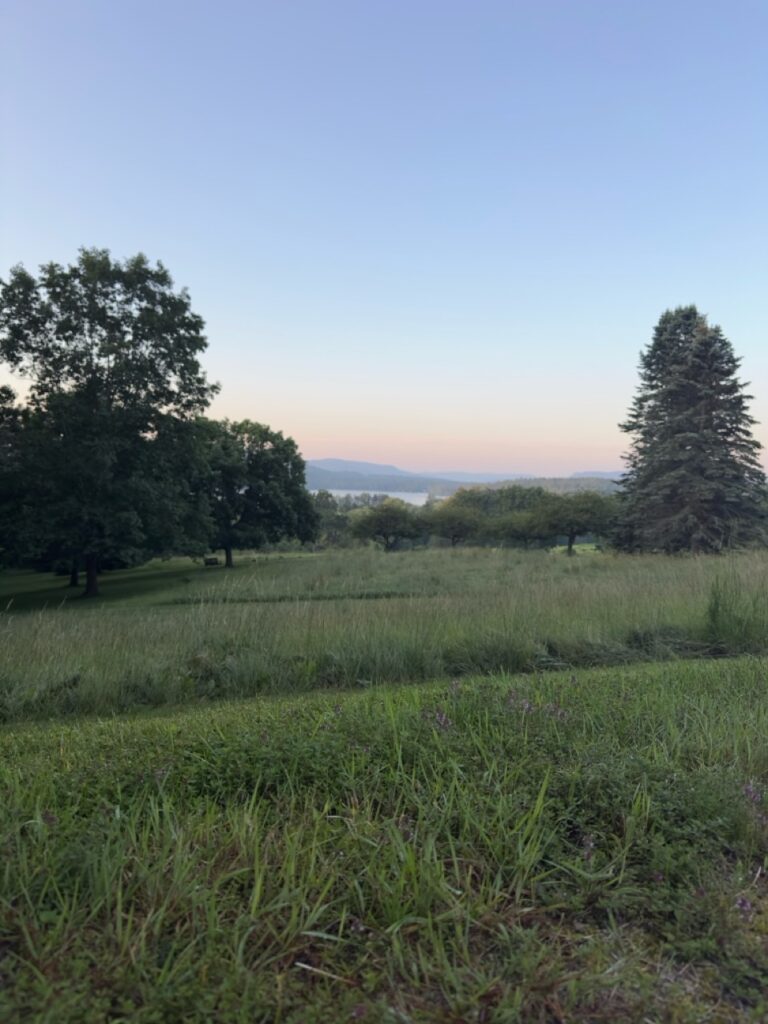
At first, it felt impossible to capture what the heck just happened – so I stuck to the surface. Yep, food was great. Yes, western Mass is beautiful, and hey, James Taylor was playing across the street! Lots of yoga, obviously. I spoke a couple of times (mainly to ask a question privately to our guide), but otherwise, I really didn’t say a word. Sharing a room with two strangers without speaking? Strangely easy. We got along great!
But deep down, I knew something had shifted. I just wasn’t sure how to describe it – or even what “it” was.
Now that I’ve had some space from the retreat, I feel more ready to try, if only to organize my own thoughts.
The Experience Itself
Silent retreats come in different flavors, with varying levels of intensity. The one I chose at Kripalu was far gentler than a 10-day vipassana, which friends tell me can be downright suffering (can’t wait!). Each day had 2–3 guided sessions, with plenty of time in between to wander the beautiful grounds, nap, read, journal, or take a yoga class. Yes, there was a lot of meditation, but usually only in 20–30 minute sessions. The facilitators did a fantastic job holding the container and then, importantly, getting out of the way.
At the end, some people said they loved the experience itself. That wasn’t me. I found it tedious. Meditation. Yoga. Noticing the breath. More yoga. More breathing. More meditation. More wondering what I should or shouldn’t do with my time. And yes, more breathing.
But that’s exactly why I went. And exactly what I needed.
What I Got Out of It
If you’re familiar with mindfulness, you know the drill: be the observer of your thoughts instead of being swept up in them. The “focus on now… oops, wandered… label it… back to now” cycle. Doing that for 10 minutes a day is one thing. Doing it for five days straight creates space for the mind to settle. And in that space… a lot happens.
Here are three ways I’d put it:
The Onion
Minutes after locking up my phone, I was walking the grounds when I instinctively reached for my pocket to take a photo. Frustration hit. Then curiosity. Why am I taking dozens of photos a day when I’ll never look at 99% of them? Why do I shove a camera in my kids’ faces whenever they do something cute? What would happen if I just enjoyed the moment?
That curiosity deepened. Over the days, I noticed how much of my mental energy is spent planning. Always planning. Even the most trivial things. Observing that planning-gremlin instead of identifying with it was liberating. Just naming it helped quiet it down. Instead of constantly planning for what’s next, I could actually be here and now.
And those were just two examples. In reality, I had many such realizations – layers peeling back, one after another, slowly falling away, revealing deeper truths about myself. On the second day, the onion metaphor landed hard for me and hasn’t let go since.
Clearing
If you know about emotional suppression and catharsis, this won’t surprise you. For everyone else, the short version: suppression means pushing feelings down; catharsis is letting them out. We all carry suppressed emotions—from trauma, childhood, or simply avoiding hard truths.
I’d experienced emotional release in other contexts—but never in meditation, and never this clearly. Out of nowhere, waves of sadness would crash over me. Instead of resisting, I let them come. Tears flowed. Minutes later, the wave receded, leaving calm waters. Sometimes memories surfaced—ordinary ones that clearly carried unprocessed emotions.
As Lao Tzu put it, letting the water settle gives space for what’s been waiting to rise.
“Stop trying to heal yourself, fix yourself, even awaken yourself… Instead, bow deeply to yourself as you actually are. Your pain, your sorrow, your doubts, your deepest longing, your fearful thoughts…are not mistakes. They aren’t asking to be healed. They are asking to be held.”
— Jeff Foster
A Deeper Connection
Michael Jackson once said, “If I’m not there to receive these ideas, God might give them to Prince.” He believed his role was simply to listen and receive inspiration.
In recent years, I’ve been chasing deeper intuition – that sense of being guided. But with entrepreneurial freedom comes paralysis: so many possible directions, which way to go?
The retreat made clear that clearing blockages—mental, emotional, physical – opens the channel for intuition. It reconnects mind and body. For the first time – perhaps ever, I feel the glimmer of intuition that was there all along, patiently waiting for me to get my act together.
“Think of the old cliché about the mind being ‘an excellent servant but a terrible master’. This, like many clichés, so lame & banal on the surface, actually expresses a great & terrible truth.”
— David Foster Wallace
Like any transformational experience, a silent retreat is personal. It may or may not be right for you right now. But if you’re curious, I can’t recommend it enough.
And now, the real work begins: not leaving the retreat behind, but continuing the daily practice. Letting the mud settle, again and again, so the water stays clear.
Huge thanks to Jess Frey and Cristie Newhart for being our guides, and sharing many of the aforementioned passages.